
Collaboration
University collaborations: turning medical silicone research into manufacturable devices
CPT works with university research groups to bridge the gap between novel silicone ideas and production-ready medical devices, with recent focus on additive-loaded silicone moulding, wound care and fluid dynamics.
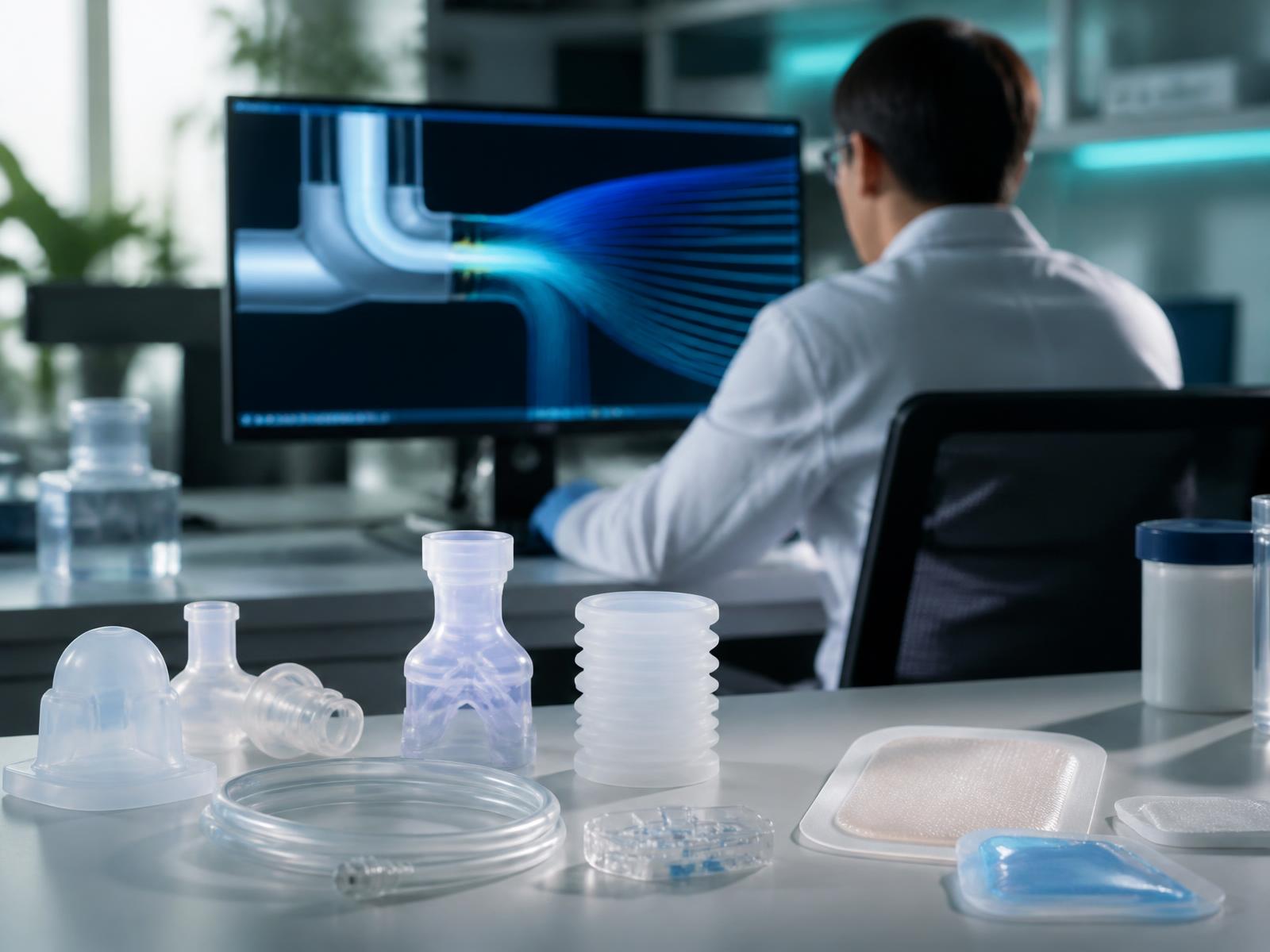
Some of the most interesting medical silicone projects we handle begin life in a university lab. A researcher has demonstrated a concept: a new way of delivering a drug, a better wound-dressing interface, a soft robotic actuator, a microfluidic seal. The question that follows is almost always the same: how do we turn this into something that can be made repeatably, at the right quality, under a medical-device quality system?
That is the gap Clinical Polymer Technologies has been helping university partners close. Over the last few years we have supported programmes in additive-loaded silicone moulding, wound care and fluid dynamics, bringing manufacturing reality into the conversation early enough that the research output can survive the transition from bench to bedside.
Why universities partner with a contract manufacturer
Academic research excels at proving a mechanism. It is less well equipped to answer the questions a device manufacturer or investor will ask next: what does the part cost at volume, what tolerances can it hold, which material grades are available with regulatory support, how is it sterilised, and can the process be validated under ISO 13485?
A contract manufacturer can answer those questions before the grant report is written. By involving CPT at the feasibility stage, a research group can design the experiment with manufacturability in mind, select materials that exist in qualified medical grades, and produce parts that look and perform like a commercial device rather than a one-off prototype.
The value is not just technical. A university that can present a credible manufacturing route alongside its published data is in a far stronger position when seeking licensing partners, follow-on funding or clinical collaborators.
Additive-loaded silicone moulding: when the material itself carries the innovation
Additive-loaded silicone moulding, the incorporation of functional fillers, pigments, antimicrobials, radio-opaque agents or active compounds into the silicone matrix, is a recurring theme in research collaborations. The academic question is usually about what the additive does: does it improve cell attachment, reduce bacterial colonisation, make the part visible under imaging, or change the surface energy?
Our question is different but equally important: can the modified material still be processed in a clean, repeatable way? Additives change viscosity, cure kinetics, shrinkage and demoulding behaviour. Some interfere with platinum cure chemistry. Some create particulate risk in an ISO 8 cleanroom. Some require post-cure profiles that the research protocol has not considered.
We help research teams understand these interactions before the material is locked in. That might mean running small-scale trials on our Arburg and MAPLAN LSR presses, testing dispersion quality across cavities, or working with the raw-material supplier to source a medical-grade version of the additive rather than a laboratory reagent. The result is a formulation that can be reproduced batch to batch, not just a promising result in a single test tube.
Wound care: soft interfaces that have to perform under pressure
Wound-care research frequently needs silicone components that interact gently with compromised tissue: soft seals for negative-pressure wound therapy, adhesive interfaces that breathe, gaskets for wearable pumps, or moulded pads with controlled compression profiles. The biological requirements are demanding, but so are the mechanical ones.
A wound-care part has to feel right, seal consistently across uneven skin, remain stable through the specified sterilisation process, and be produced in a cleanroom environment where particulate and bioburden are controlled. It also has to be affordable enough that a single-use disposable model makes commercial sense.
In collaboration with university groups, CPT has helped translate wound-care concepts into moulded designs that can be produced at volume. That involves choosing the right Shore hardness, optimising the parting line so it does not sit on a patient-contact surface, selecting a sterilisation route that does not degrade the silicone, and designing packaging that protects the part through shelf life. These are not afterthoughts; they determine whether the research can leave the lab.
Fluid dynamics: when the flow path is the device
Microfluidics, drug-delivery valves, diagnostic cartridges and respiratory interfaces all depend on precise fluid behaviour. University partners often come to us with computational fluid dynamics models or 3D-printed prototypes that prove the concept, then need a silicone component that reproduces those flow characteristics at volume.
Silicone is an excellent material for fluid-contact applications: it can be moulded with thin, flexible membranes, precise valve seats, and complex internal channels. It is also biocompatible, sterilisable and available in grades with extensive regulatory support. The challenge is that the transition from a printed prototype to a moulded part changes everything: surface finish, dimensional tolerance, material elasticity and the presence of flash or parting-line witness all affect flow.
We work with researchers to close the loop between simulation and moulded reality. That means understanding what the CFD model assumed, identifying which dimensions are actually critical to flow, and designing the tool so that the moulded part matches the model within a useful tolerance. Where possible we produce validation samples that the research team can test against their simulation, refining both until they agree.
What CPT brings to a university partnership
Our contribution is not simply "make the parts." It is a structured route from concept to commercialisable device:
- Design for manufacture: early review of CAD, material selection and process route to avoid locking in avoidable cost or risk.
- Medical-grade materials: working relationships with NuSil, Wacker, Shin-Etsu and Momentive, with access to regulatory support files and implant-grade options.
- Tooling and trials: prototype tooling through production multi-cavity cold-runner LSR tools, managed in-house or through our approved toolmakers.
- ISO 8 cleanroom manufacture: moulding, assembly, inspection and packaging under environmental controls appropriate to medical devices.
- Quality system: ISO 13485:2016 certification with batch traceability, process validation (IQ/OQ/PQ), and technical dossiers suitable for customer regulatory files.
- Scale-up: a path from tens of parts for clinical evaluation to millions of parts per year without changing the fundamental process.
How a collaboration works
Most projects follow the same arc: the research team shares the concept, target application and any existing data; we review design for manufacturability, propose material and process options, and quote for a feasibility batch. Parts are then produced under our ISO 13485 quality system with full traceability, ready for preclinical studies, regulatory submissions or investor demonstrations. The same manufacturing route can later be validated and scaled, so there is no supplier switch between prototype and production.
We support academic researchers, postdoctoral groups, medical-device spin-outs and university technology transfer offices. The most productive collaborations bring manufacturing in early, while the design is still flexible.
Get in touch
If you are running a research programme that involves silicone components, or you have a concept that needs a credible manufacturing route, please contact the CPT engineering team. We are happy to review concepts under confidentiality and to advise on the most direct path from research idea to production device.