
Materials expertise
Medical-grade silicone components, matched to the application.
CPT works across an extensive range of medical-grade silicone and elastomer materials, LSR from 5 to 80 Shore A, HCR, fluorosilicone, RTV and UV-cure, supported by an in-house materials mill and 30+ years of technical knowledge.
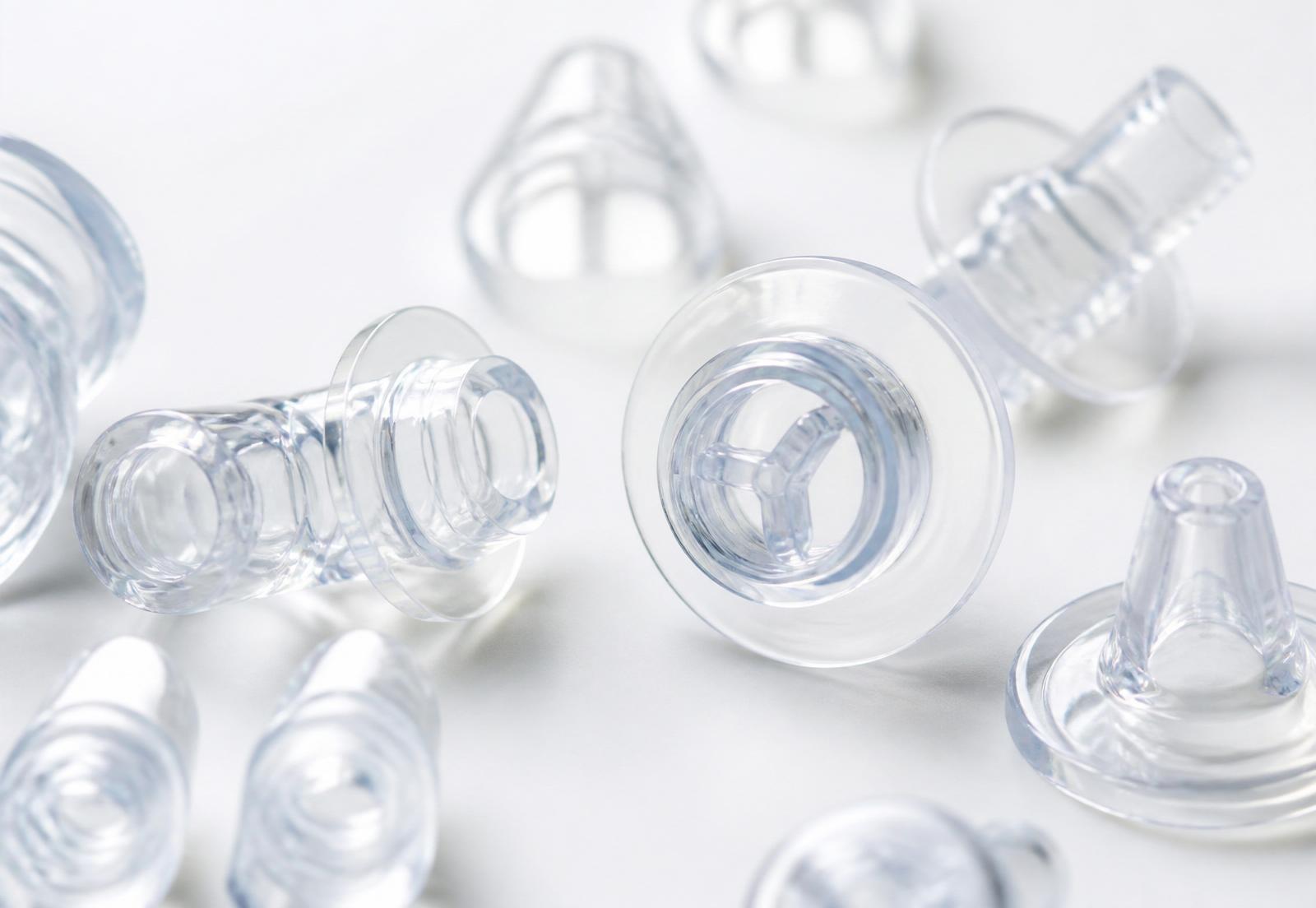
Material selection
From standard medical grades to specialist functional compounds.
CPT can contribute to design and material selection at project inception. The company works with the principal medical-grade silicone suppliers and can specify, trial and validate materials including LSR, HCR, RTV, additives, pigments, coatings, conductive compounds and implant-grade systems.
Specific compound recommendations and biological evaluation support are available on request.
Material categories
The material categories CPT works with routinely.
Select a category to expand its detail. Each entry outlines typical applications, available processing routes and the principal considerations CPT evaluates when specifying a material.
Overview
Platinum-cured two-part LSR systems from the principal medical-grade silicone suppliers.
CPT works closely with NuSil, Wacker, Shin-Etsu and Momentive to specify the appropriate LSR grade for each application. The combination of low viscosity, rapid cure and a wide durometer range makes LSR well suited to thin-wall medical parts, overmoulded electronics and high-volume consumables.
Detail
- Platinum-cured, two-part addition cure systems
- Shore A hardness from 5 to 80+
- Medical, optical, electrical and self-lubricating grades
- Pigmented, translucent and opaque formulations
- Fast-cycle, high-volume precision moulding
Overview
Traditional high-consistency silicone processed by compression, transfer and injection moulding.
HCR is supplied as a thick, pre-catalysed material and remains the standard for larger cross-sections, legacy parts and specialist formulations. It is available with peroxide or platinum cure systems and is well suited to low-volume, prototype and thick-walled components.
Detail
- Peroxide- and platinum-cured grades
- Thick-walled, large-section and gasket components
- Fluorosilicone, heat-stabilised and steam-curable variants
- Suitable for compression and transfer tooling
- Well suited to legacy tool re-life and specialist trials
Overview
Room-temperature vulcanising silicones for tooling, potting, encapsulation and repair.
RTV materials cure at ambient temperature by condensation or addition chemistry, and UV-curable grades offer rapid fixturing without heat. CPT uses them for prototype tooling, moulds, encapsulation, gap-filling and low-volume cast parts where oven curing is impractical.
Detail
- Condensation and addition-cure RTV systems
- UV-accelerated and UV-cure grades for fast processing
- Potting, encapsulation and soft tooling
- Low exotherm, low shrink options for delicate parts
- Prototype and repair applications
Overview
Functional additives to tune mechanical, radiological or processing behaviour.
Additives can be compounded into silicone to change density, radio-opacity, colour, conductivity, thermal performance or cure speed. CPT selects and validates fillers to meet medical device requirements without compromising biocompatibility or processability.
Detail
- Barium sulphate for X-ray / radio-opaque components
- Tungsten and bismuth fillers for high-density imaging
- Fumed silica for rheology and tear-strength control
- Heat stabilisers, flame retardants and colourants
- Lot-controlled formulation and traceability
Overview
Opaque, translucent and custom-matched colours for device identification and branding.
Medical-grade pigments are selected for dispersion stability, cure compatibility and long-term colour fastness. CPT can match brand colours, produce translucent tints, or use contrasting pigments to distinguish sizes, flows or left/right parts.
Detail
- Opaque, translucent and custom colour matching
- Medical-grade pigment masterbatches
- Size or flow identification via colour coding
- Stable dispersion in LSR, HCR and RTV
- Biocompatibility-assessed pigment systems
Overview
Long-term implant silicones validated for residence times greater than 29 days.
Implant-grade silicones are manufactured and tested to stricter purity and extractable limits than standard medical grades. CPT works with long-term implant materials for applications where the device remains in contact with tissue for more than 29 days.
Detail
- Long-term implant silicones (> 29 days contact)
- Ultra-low volatile and extractable content
- Full material traceability and batch records
- Compatible with ethylene oxide and gamma sterilisation
- Supported by ISO 10993 and relevant biological evaluation
Overview
Materials selected and documented against recognised biological safety standards.
CPT chooses materials with the right biological evaluation profile for the intended contact type and duration. ISO 10993 series testing and USP Class VI biological reactivity data are used to support device submissions and customer risk assessments.
Detail
- ISO 10993 biological evaluation planning
- USP Class VI classification data
- Cytotoxicity, sensitisation and irritation profiles
- Material selection matched to contact duration and route
- Documentation for regulatory submissions and technical files
Overview
Antimicrobial silicone compounds with ionic silver for infection-sensitive applications.
Silver-loaded silicones release silver ions to inhibit microbial colonisation on the device surface. They are used in catheters, wound care devices and long-term implants where reducing bioburden is clinically important.
Detail
- Ionic silver antimicrobial additives
- Catheter, wound and implant applications
- Controlled release without compromising mechanical properties
- Compatible with platinum LSR cure systems
- Supported by biological and shelf-life validation
Overview
Carbon-filled silicones for EMI shielding, static dissipation and conductivity.
Carbon black, graphite or other conductive fillers can give silicone controlled volume resistivity. These compounds are used for EMI shielding gaskets, ESD protection, touch-sensor interfaces and electromechanical seals.
Detail
- Carbon-loaded silicone for conductivity / shielding
- EMI gasket and electromechanical seal applications
- ESD-safe and static-dissipative grades
- Volume resistivity tuned to application needs
- Compression and injection mouldable forms
Overview
Low-friction, lubricious and functional coatings for silicone medical devices.
Coatings reduce coefficient of friction, improve insertion, prevent tackiness and add chemical resistance. CPT can specify and apply silicone-compatible coatings, including low-COF lubricious layers, parylene and plasma treatments where appropriate.
Detail
- Low coefficient of friction (COF) lubricious coatings
- Hydrophilic and hydrophobic surface treatments
- Parylene and thin-film barrier coatings
- Plasma or corona surface activation
- Improved insertion, release and cleaning performance
Overview
Bonding systems that make silicone adhere to metals, ceramics, glass and other substrates.
Silicone is naturally low-energy, so primers and adhesives are essential for durable overbonding. CPT selects solvent- and solvent-free primer systems for overmoulding onto stainless steel, titanium, glass, ceramics and polyimides.
Detail
- Silicone-to-metal bonding primers
- Silicone-to-ceramic and silicone-to-glass adhesion systems
- Adhesives for PCBs, wiring, sensors and LEDs
- High-temperature and autoclave-resistant bonds
- Solvent-free options where device chemistry requires