
Materials
Selecting LSR for drug-delivery applications: a practical guide
Durometer, extractables, cure system and secondary operations all shape whether a liquid silicone rubber is the right choice for a drug-delivery seal, valve or reservoir component.
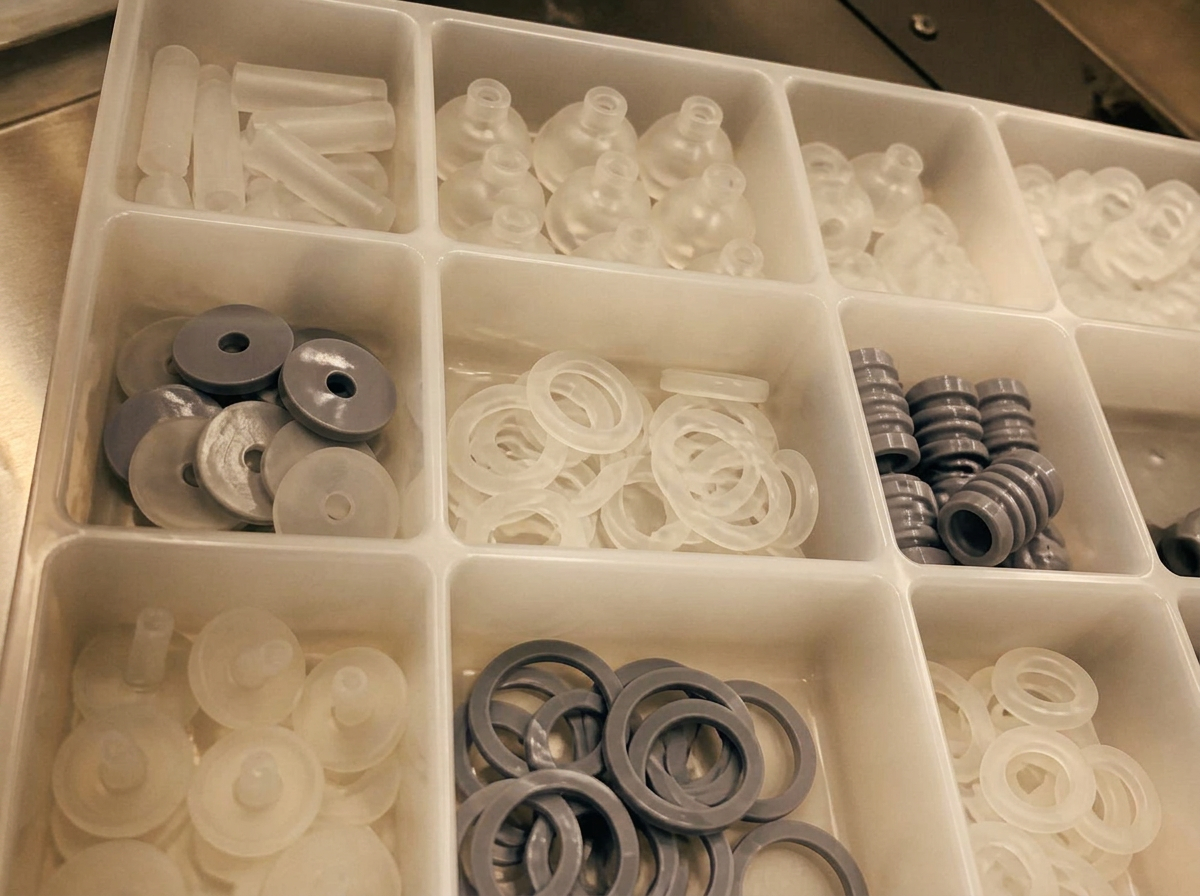
Liquid silicone rubber (LSR) is the default elastomer for many drug-delivery components, seals, duckbill valves, septa, plungers, reservoir bladders, because it combines biocompatibility, thermal stability and consistent processing at high cavitation. Selecting which LSR, however, is rarely a straightforward decision.
Correct selection integrates the material into the design: the valve cracks at the target pressure, the seal survives sterilisation, the plunger glides for the full shelf life, and the biocompatibility file can lean on the raw-material supplier's data with confidence. Incorrect selection introduces the full range of failure modes, tackiness, extractables surprises, dimensional drift, incompatibility with the drug formulation, typically discovered late in development, when correction is expensive.
Start with contact duration and route
ISO 10993-1 categorises devices by contact type and duration, and that categorisation is where LSR selection actually begins. For drug-delivery components, the practical split is short-term fluid path versus implantable or long-term contact.
Short-term fluid contact: think inhaler valves, auto-injector seals, IV set components, typically resolves to a medical-grade LSR with USP Class VI and ISO 10993-5/-10 support from the raw material supplier. The Wacker Elastosil LR 30xx, Shin-Etsu KE-2000 and Momentive Silopren LSR 20xx series sit comfortably in this space.
Implant-grade contact: greater than 29 days per ISO 10993, shifts the conversation to specialist grades: NuSil MED, Wacker's implant-grade Elastosil, Shin-Etsu KEG series or Momentive's Silopren implant range, each with a Device Master File or equivalent regulatory support that a device manufacturer can reference in their submission.
The regulatory categorisation must be settled before the design decision. A silicone specified for 24-hour contact and subsequently applied to 30-day contact is a file rewrite, not a material substitution.
Durometer is a design decision, not a look-up
Shore hardness is the most frequently quoted LSR property and, in practice, the most commonly misunderstood. The appropriate value depends on the mechanical duty of the part, not on convention or a competitor's specification.
- Softer LSRs (20–40 Shore A) seal at lower closing forces, tolerate misalignment and demould more readily on thin sections. They also flash more easily, are more difficult to automate through downstream assembly and are more prone to surface tack, which can affect vision inspection.
- Mid-range (40–60 Shore A) serves as the reference range for most drug-delivery seals, sufficient resilience to seal reliably, sufficient dimensional stability to support automated assembly and a wide selection of qualified grades from all four principal suppliers.
- Harder grades (60–80 Shore A) deliver the dimensional stability and repeatable cracking pressure required for duckbill valves, umbrella valves and precision flow-control components. They require more attention to tool design; sharp features flash less forgivingly at higher durometer.
The appropriate selection is almost always established through a DFM discussion involving the device designer, the material supplier and the moulder, rather than through a specification-sheet decision taken in isolation.
Extractables, leachables and drug compatibility
Peroxide-cure silicones are now largely absent from LSR selection for drug delivery. Platinum-cure is the default, provides the cleaner extractables profile that E&L studies require and avoids the by-products (2,4-dichlorobenzoic acid and related species) associated with peroxide chemistry. Even so, secondary post-cure is often specified to drive off residual volatiles before packaging, typically several hours at elevated temperature, with the exact profile validated against the specific grade and part geometry.
Drug compatibility is a separate consideration. LSR can sorb small lipophilic drug molecules and can leach silicone oligomers into contact solutions in trace quantities. For any parenteral or inhalation programme, an extractables study on the finished, sterilised part, rather than solely on the raw material, provides the definitive dataset. Bridging arguments from a similar drug or a similar part are possible, but only where the underlying analytical work supports them.
Additives, specify with intent
Every additive changes the biocompatibility file as well as the functional behaviour. Common choices in drug-delivery LSR include:
- Barium sulphate for radio-opacity, where the component must be visible under X-ray or fluoroscopic imaging. Loading level trades opacity against mechanical properties and demoulding behaviour.
- Pigments selected from medical-grade masterbatches, with opacity or translucency chosen to suit downstream vision inspection. A pigmented seal that cannot be reliably inspected creates a validation issue, not simply an aesthetic one.
- Silver-loaded grades, where antimicrobial performance forms part of the design intent, increasingly relevant to reusable device applications.
- Carbon-loaded grades for controlled electrical conductivity, occasionally applied in sensor-integrated drug-delivery devices.
Each choice moves the biocompatibility file in a specific direction and introduces an additional variable that must be justified in the technical file. Historical precedent alone is not a defensible position under a rigorous Notified Body review.
Cure system and processing window
Platinum-cure LSR is sensitive to cure inhibitors. Nitrogen-, sulphur- and tin-containing compounds can retard or arrest cure at trace levels. This has implications for material handling (certain elastomers, gloves and adhesives are known contaminators), for insert overmoulding (substrate cleanliness is not optional) and for tool steel selection. On new programmes CPT routinely conducts a cure-inhibition check before committing to tooling geometry. The cost of identifying an inhibition problem after tool sign-off is disproportionate to the cost of identifying it early.
Don't forget the secondary operations
The material selection conversation should include everything that will happen to the part after it leaves the mould:
- Parylene or PTFE-derivative coatings for low coefficient of friction on plungers and stoppers.
- Plasma treatment for surface activation prior to bonding.
- Primer and adhesive selection for silicone-to-substrate overbonding, the adhesive system usually has to be qualified against the specific LSR grade, not just against "silicone".
- Sterilisation route (EO, gamma, autoclave, e-beam) and its effect on colour, mechanical properties and extractables.
- Packaging materials and shelf-life claims, which depend as much on the LSR's long-term behaviour as on the packaging itself.
Incorporating these considerations into the DFM review at the material-selection stage, rather than after tool sign-off, is the single most effective cost control on a drug-delivery LSR programme.
Working with CPT
The CPT engineering team works with NuSil, Wacker, Shin-Etsu and Momentive daily and can support material down-selection alongside tool design and process development. For new programmes, second-source qualifications or legacy parts that are not performing in line with the data sheet, please make contact via the contact page to arrange a technical review.