
Materials
Sterilisation and silicone: how gamma, e-beam and EtO affect mechanical properties
Gamma, e-beam and ethylene oxide all sterilise silicone, but they do not treat every grade equally. What published test data shows, and why cure system matters when you specify a sterilised component.
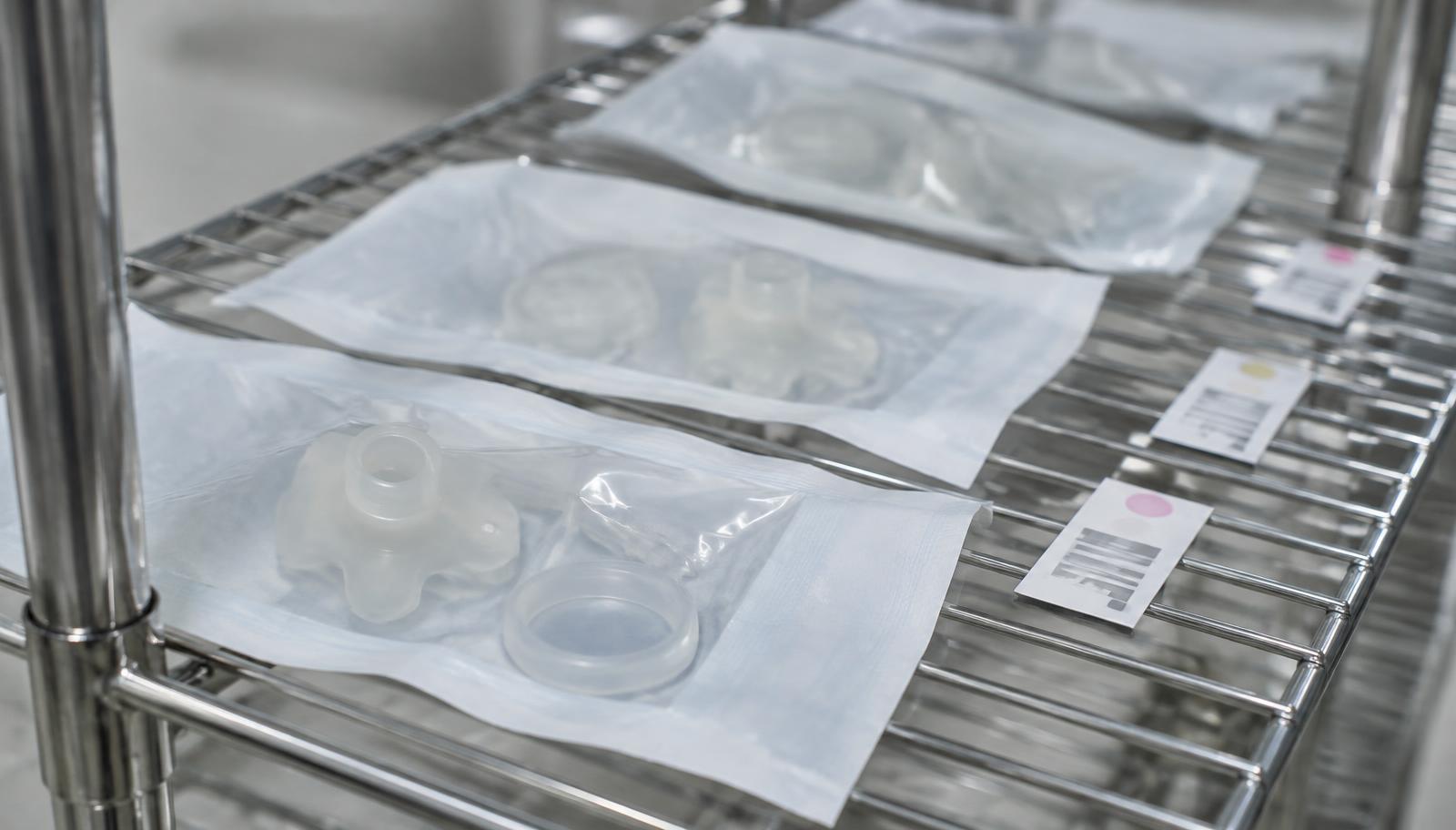
Almost every silicone component we mould for medical and pharmaceutical use will be sterilised before it reaches a patient or a process line. Sterilisation is non-negotiable, but it is not neutral. The method and the dose both change the material, and the size of that change depends heavily on the type of silicone selected.
A study published by Saint-Gobain's Northborough R&D Centre tested three commercial silicone types before and after the three most common sterilisation methods. The results are a useful guide for anyone choosing a material and a sterilisation route at the same time, which is exactly when the decision should be made.
The three materials tested
- Platinum-cured liquid silicone rubber (LSR), the material used for most precision injection moulded medical parts.
- Platinum-cured high consistency rubber (HCR), commonly used for compression moulded and extruded parts.
- Peroxide-cured HCR, an older, lower-cost cure chemistry still found in many general-purpose applications.
The grades tested were Wacker Elastosil LR3003/50 (LSR), Wacker Elastosil R4000/50 (platinum-cured HCR) and a peroxide-cured Bayer base rubber. Each was exposed to gamma irradiation (25, 50 and 75 kGy), electron beam irradiation (10, 40 and 80 kGy) and ethylene oxide (EtO) gas. Hardness, tensile modulus, elongation, tensile strength and tear strength were then measured, with each point the average of five specimens.
Why radiation changes silicone
Gamma and e-beam energy break bonds in the silicone polymer and create free radicals. Some of those radicals form new crosslinks, which makes the rubber harder and stiffer. Others cut polymer chains. The net effect is a material that is firmer, less stretchy and, in most cases, less tear resistant than it was when it left the mould.
Gamma penetrates roughly five times deeper than e-beam but delivers its dose over several hours. E-beam can reach the required dose in under a minute, so there is less time for oxidation to take place. That difference shows up in the data.
Gamma irradiation
Peroxide-cured HCR was affected most. After 75 kGy its hardness rose by more than 10 Shore A, its modulus more than tripled, elongation fell by up to 75% and tensile strength halved. Tear strength dropped by 45%.
The platinum-cured materials held up far better. Elongation fell by 45% for LSR and 35% for platinum HCR at the same dose, tensile strength was barely affected, and platinum HCR lost around 30% of its tear strength. Hardness and modulus rose only slightly.
E-beam irradiation
E-beam was generally gentler than gamma, consistent with its much shorter exposure time. Peroxide-cured HCR again changed the most, gaining 14 Shore A and 160% in modulus after 80 kGy, with a 62% loss of elongation. LSR and platinum HCR lost 33% and 39% of elongation respectively. A low 10 kGy dose had minimal effect on tear strength, while higher doses reduced it by 35% to 40%.
Ethylene oxide
EtO does not rely on radiation, and its effect was negligible for hardness, tensile modulus and tear strength across all three materials. Tensile strength improved, by nearly a third for LSR and by around 13% for the platinum-cured HCR, and LSR also gained about 20% in elongation. The authors conclude that EtO had no significant negative effect on the materials tested and describe it as the preferred method for silicone fluid transfer products. For components where mechanical performance has to be preserved precisely, it is often the safest route, provided residuals, aeration time and packaging are managed correctly.
What this means when you specify a part
- Cure system matters more than most people expect. On this data the authors do not recommend peroxide-cured silicone for any product that may be sterilised by radiation. Platinum-cured LSR and HCR are the better choice where gamma or e-beam is planned.
- Design to the sterilised properties, not the datasheet. A seal or valve that is right at 50 Shore A as moulded may be noticeably firmer after gamma. Tolerances, compression set and actuation forces should be confirmed on sterilised samples.
- Know your dose and whether it repeats. A single 25 kGy cycle is very different from a part that may be resterilised several times. Higher cumulative doses mean bigger changes.
- Fillers and additives change the picture. Tensile and tear behaviour depend on filler type and treatment, and coloured, radiopaque or otherwise additive-loaded grades should be validated individually.
- Decide early. Choosing the sterilisation method alongside the material avoids requalification later.
How CPT can help
We mould platinum-cured medical silicone in our ISO 13485 certified, ISO Class 8 cleanroom facility in Coalville. When a project starts, we will talk through the intended sterilisation method and dose with you and recommend grades suited to it, so that properties can be confirmed after sterilisation rather than assumed.
If you are weighing up gamma, e-beam or EtO for a silicone component, get in touch and we will help you make the decision with the data in front of you.
Source: E. Gautriaud, K. T. Stafford, J. Adamchuk, M. W. Simon and D. L. Ou, "Effect of Sterilization on the Mechanical Properties of Silicone Rubbers", Saint-Gobain Performance Plastics white paper, 2009, also published in BioProcess International, April 2010. The study was carried out on silicone tubing and hose for fluid transfer. Results relate to the specific commercial materials tested and should be confirmed for any given grade and process.